Sunday, February 13, 2011

Chapter 2: First Farmers

Chapter 2: First Farmers
The Revolutions of Agriculture
1o,ooo B.C.E - 3ooo B.C.E
The Agricultural Revolution in World History
  • Men & women began "directing" the process of evolution
  • Animals transformed by selective breeding i.e sheep with more wool, cows with more milk, etc
  • "Domestication" -- the taming & changing of nature for the benefit of human beings
  • Mutual Dependence 
  • Getting more for less -- more food meant more people


Comparing Agricultural Beginnings
  • Neolithical revolutions occurred independent of one another, scattered across the world 
  • Took place 12,ooo & 4,ooo years ago

Comparing Agricultural Beginnings
  • Agricultural Revolution coincided with the end of the last Ice Age
  • Ice Age coincided with the migration of Homo Sapians -- created new conditions that made agricultural possible
  • Active hunting & climate changes pushed extinction of large mammals
  • Warmer, wetter & stable conditions helped create conditions good for tropical plants -- which were the ancestors of domesticated crops
  • "broad spectrum diet"
  • In the Middle East people developed sickles to cut grain, baskets to carry it, mortars and pestles to remove husk and storage pits for preservation
  • Learned to cut back plants and encourage growth of plants they prefered
  • women were more involved in the gathering, and therefore scholars believe they were the innovators of farming, while men were probably in charge of domesticating animals
  • the process of agriculture was a long process of human exploration
  • Technology & natural global warming helped hunting and gathering people settle in more permanent homes and abandon their nomadic ways -- exploiting the surrounding area
  •  Demands for food in a growing population was one of the causes for the start of agricultural innovation


Variations
  • Fertile Crescent -- first place to experience full agricultural revolution
  • Rich array of species capable of domestication avalible
  • Cold, dry spell triggered the need to domesticate
    • Figs, wheat, barley, rye, peas, lentils, sheeps, goats, pigs and cattles
    • Foundation for produtive agricultural societies to follow
  • In Africa around the same time, more domestication was occurring
    • Saharan desert non-existent 1o,ooo - 5,ooo years ago
    • Had grassland vegetation and frequent rainfall
    • Cattle domestication began before plant domestication
    • Sub-saharan Africa had scattered farming pratices
    • Sorghum -- first grain to be "tamed"
    • Enset, Teff, yams, oil palm trees, okra and the cola nut emerged scattered throughout africa
    • Sorghum, castor beans, gourds, millet, the donkey spread throughout Eurasia
  • In the Americas domestication of plants occurred in different locations
  • Lack of animals that could be domesticated -- only had the llama
  • Because of this they relied more on hunting and fishing for meat
  • Americas also lacked cereal grains -- had Maize instead
    • less nutrious than cereal grains, had to be supplemented with squash and beans
  • Agricultural practices could not spread quickly because of geography of Americas


The Globalization of Agriculture
  • Diffusion -- gradual spread of agricultural techniques, but not of the people themselves
  • neighboring groups communicated ideas and products
  • slow migrations of agricultural people also caused expansion
  • movement of culture reflected in change of languages 
  • Palolethic people slowly vanished 
  • The globalization took 1o,ooo years
  • Some of the hunter and gathering people chose to resist this reformation
  • By the start of the Common Era, they dwindled in numbers -- succumbing to the relentless expand of agricultural societies -- takin out by disease, intermarriage, or even  violence

The Culture of Agriculture
  • World population shot up from 6 million to 50 million during the Agricultural revolution
  • Farming meant more hard work, and lots of it
  • Diseases from animals, such as small pox, measles, and the flu, generated epidemics
  • This time period witnessed explosion of technological innovation
  • Loom operated by women
  • "Secondary products revolution"
    • milking livestock
    • harvesting wool
    • manure
  • Growing impact on the environment -- deliberately altered the ecosystem


Social Variation in the age of Agriculture
  • Resources opened up potential for growth of societies:
  • Pastoral Societies:
    • Regions where farming was difficult , people relied more on their animals, relying on milk, meat and blood
    • These people emerged in Central Asia, the Arabian Peninsula, the Sahara and parts of Africa
    • Domestication of horses enabled the growth of pastoral people
    • Camels made it possible to occupy previously inaccessible land
    • Grasslands enabled cattle raising pastorals
    • There were no such societies in the Americas
    • Relationship between nomadic herders and farmers = major theme of Afro-Eurasian history
    • conflict as pastoral peoples were attracted to the wealth of the agrarian societies
    • biblical story of rivalry between Cain, a "tiller of the ground," and Abel a "keeper of sheep," 
    • It wasn't all conflict, there was also peaceful exchanges of ideas and technological enhanced both societies
  • Agricultural Village Societies
    • settled village based farmers 
    • similar to the independence and equality in Hunting & Gathering societies
    • Little social inequality, men and women could carry out a series of roles and positions
    • Lineage system preformed the function of government without the formalities
    • Village based societies could develop social and economical inequalities
    • Elders could exploit labor of juniors, sough to control reproductive powers
    • Lineage's sought to expand numbers, and often take in slaves
  • Chiefdoms 
    • Inherited positions of power and privilege -- chiefs however could not use force to compel obedience, instead they relied on generosity, gift giving or personal charisma
    • chiefs held important rituals and ceremonies, organized community for warfare, directed economy, resolved internal conflicts
    • collected tribute from commoners and used these materials to give back to warrior, craftsman and otehr subordinates

Personal Reflection: The development of agricultural technology seemed to be entirely beneficial to the growth of mankind, however I see little benefit to the earth as a whole. The Neolitical revolution was the gateway to a downfall of the environment, as humans became the dominating species, destroying other species. "Agriculture provided humankind with the power to dominate nature, it also, increasingly, enabled some people to dominate others," I found it very disheartening. The Hunting & Gathering lifestyle seemed to be the most peaceful and efficient way for people to coexist with nature without completely dominating and potentially destroying it. 


elation station

Thursday, February 10, 2011

Chapter 1: First Peoples: Notes


CHAPTER 1: First Peoples
Populating the Planet
(see p.7 for notes on dates) 
  • Hunting & Gathering lifestyle sustained human kind for more than 95% of the time that our species have occupied the earth
  • Human beings adapted to a wide variety of enviorments even without agriculture
  • Gathered wild berries, nuts, roots & grains, scavenged dead animals, hunted life animals & fished
  • Like any animals these people "borrowed" what nature offered, using stone tools
 Out of Africa to the Ends of the Earth:: First Migrations
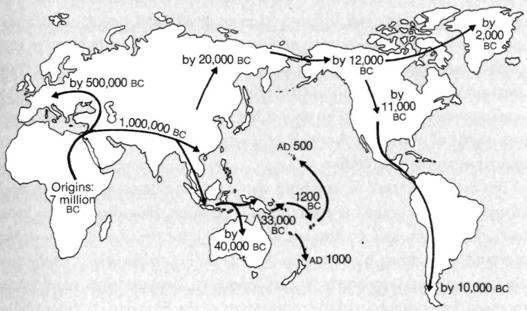
  • First 15o,ooo years of human history was only in Africa
  • Homo sapiens emerged about 25o,ooo years ago
  • Technological innovations such as "hand axes" appeared, tools made from bones & grindstones, as well as evidence of hunting & fishing
  • Settlements planned around seasonal movement of game
  • Social & cultural behavior marked by body ornaments, beads, etc
  • Migration began sometime after 1oo,ooo years ago to Eurasia, Australia, the Americas and the Pacific (see Map 1.1, p.13)
  • Learned how to occupy every climate on the earth with only a few tools
Into Eurasia
  • Human migration led to Middle East, then wast to Europe about 4o,ooo yrs ago , then east to Asia
  • Images were left in cave paintings
  • Bone needles, multilayered clothing, weaving, nets, storage pits, baskets & pottery all found as adaptions to Ice Age
  • Underground dwellings made of tusk & bones for when caves & rock shelters were absent
  • Venus figurines depicted female form (often exaggerated breasts, butt, hips and stomach -- probably to represent fertility) made from bones, antlers and baked clay
Into Australia
  • 6o,ooo yrs ago humans came from Indonesia from Australia by boat
  • When Europeans arrived in 1788, Australia's people were still practicing ancient ways of living
  • These people focused on technological simplicity and a tradition known as Dreamtime
  • This tradition was expressed in folklore, rock art & recounted the begining of things; how people came to inhabit earth, how we relate to animals
  • "In this view of the world everything in the natural order was a vibration, an echo, a footprint of these ancient happenings, which link the current inhabitants intimately to particular places and to timeless events in the past" (p.17)
  • Used song, dance, psychoactive drugs, stories, & rituals
  • Each community was loosely connected
Into the Americas
  • This part of the world was occupied much later than Australia b/c of the difficulty caused by the cold of Siberia
  • First migrations occured somewhere between 3o,ooo & 15,ooo years ago. 
  • Evidence of human activity in southern Chile 12,5oo years ago
  • Clovis people -- first defined cultural tradition in Americas
  • They were hunters of large animals, i.e mammoths & bison
  • Flourished 12,ooo - 11,ooo years ago
  • Clovis people disappeared around the time many large animals became extinct 
  • People of the Americas began to pursue bison, some learned to live in the desert for small game and plants, others near the sea for birds and fish
Into the Pacific
  • Last phase of human migration, occuring only about 3,5oo years ago
  • Migrated by canoe and navigational skills
  • These people already had agriculutral techology and carried plants and aniamls in canoes to colonize
  • Settling in the previously unoccupied islands caused many animals to go extint, especially flightless birds
  The Ways We Were

The First Human Societies
  • Paleolthic societies were small (25-5o people)
  • Relationships were personal
  • These bands of people were small and nomadic, moving in patterns to use the land to it's fullest potental
  • Highly egalitarian societies -- they lacked the inequalities of wealth & power that came from the Agricultural Era
  • No class differences, people were freer of oppression than any other human society
  • Most people possessed similar skill sets (though men and women often had different tasks)
  • Women were primarily food gathers, providing for 7o% of the diet while men hunted
  • There were some rules in regards to distribution of meat,  incest & adultery as well as who could hunt in what territories. 
Economy & the Enviornment
  • Hunting & Gathering people often viewed as "primitive" however, anthropologists now note that these people worked fewer hours to meet their needs than agricultural or industrial societies -- and therefore had more time for leisure
  • They wanted or needed very little
  • Llife expectancy was low, about 35 yrs on average and living in the wild was dangerous
  • These people shaped nature and the land with their own hands

The Realm of the Spirit
  • Clear evidence of a rich ceremonial lifestyle
  • Rock art suggests ceremonial spaces
  • People often used psychoactive drugs during ceremonies
  • Some societies were monotheistic, others saw many levels of supernatural beings, including a Creator Deity, territorial spirits, & spirits of the dead
  • Cyclical view of time that drew on changing phases of moon & female fertility
Settling Down: "The Great Transition,"

  • major change of Paleolithic peoples occurred as the last ice age came to an end
  • followed by a general global warming, that was a natural phenomena
  • Plants & animals that had once been unable to flourish b/c of the Ice Age's chilly climate were now able to thrive
  • Under the improved conditions human beings thrived
  • societies became larger & more complex as people started to settle down into permanent residences
  • inequalities slowly began to form
  • Paleolithic societies in Japan known as Jomon, settled by the sea, creating some of the world's first pottery, dugout canoes, paddles, bows, bowls and tool handles from wood
  • Bows & Arrows were invented separately in Europe, Africa & the Middle East, spreading later to the Americas
  • Settling down marked a huge turning point in human history & placed a much greater demand on the environment
  • Agricultural societies followed soon after


 Comparing Paleolithic Societies

The Sans of Southern Africa
  • North of Kalahari Desert 
  • San people numbered 5o,ooo -- 8o,ooo
  • Great language family of Africa -- speaking Khoisan
  • Hunting & Gathering lifestyle
  • Rock art of  people and animals, thousand of naturalistic scenes of hunts, battles & dances
  • Sans group called Ju'hoansi meaning "real people"
  • Lived in harsh conditions of Kalahari, used 28 tools (wooden shovel,  large leather bag, a knife, a spear, a bow & arrow tipped with poison, woven ropes & nets)
  • Discovered and named 260 species of wild animals & 100 species of wild plants were collected by the gatherers and they had a well balanced diet
  • lifestyle of mobility, sharing and equality
  • bands made of 10-30 people
  • moved every few months or so
  • camps consisted of grass huts
  • Jo'hoansi society was simple, no formal leaders -- decisions were made by individuals 
  • social relationships were complex
  • nicknaming type of system to form relationships
  • intense personal relationships were values of modesty, cooperation and equality
  • unequal gift exchanges "we don't share with things; we share with people"
  • economic system aimed at leveling wealth rather than making it
  • social equality amongst men and women too
  • female virginity not relevant, no double standards, polygamy permitted 
  • Creator God gave rise to earth -- Gao Na -- (similar to Zeus of Greek mythology as he was capricious 

The Chumash of Southern California
  • Located in Southern California 
  • More varied environment than the Sans people 
  • Lived on the coast & had a rich variety of resources
  • Population of about 2o,ooo people
  • Overhunting and food shortages increased level of violence in these people
  • huge technological advances -- such as a planked canoe that could cross the ocean and hold two tons
  • these boats made it possible to go deep sea fishing
  • lived in permanent housing, covered in reeds (some 50 ft in diameter)
  • bones, plates, baskets -- and a market based system 
  • emergence of politically elite amongst the Chumash
  • Europeans destroyed Chumash society 
Personal Reflection: 


Part 1 : The Big Picture : Notes

Turning Points in Early World History

The Emergence of Humankind
  • The human evolutionary line (Homo Sapiens) originated 5-6 million years ago in eastern and southern Africa
  • 20-30 species of Homininae or hominid (human like creatures) that shared bipedalism (ability to walk on two legs)
  • as time passed brains began to grow
  • 2.3 million years ago, Homo habilis made and used tools
  • 1 million years ago, Homo erectus migrated from Africa and discovered fire
  • All these species died out, except Homo sapiens, emerging from Africa as well about 25o,ooo years ago. Migration started about 1oo,ooo years ago to Eurasia, Australia and eventually the Western Hemisphere
 
 The Globalization of Mankind
  • Major human migrations took place in the  paleolithic ("stone age") era
  • During this era Homo sapiens began to colonize the world

The Revolution of Farming & Herding
  •  As of 2008, 6.6 billion people lived from food grown on farms and gardens, & domestic animals
  • Before 11o,ooo years ago humans lived as hunting-gathering societies
  • Food production initially depended purely on luck, climate and  soil -- & on the conditions and wildlife available for domestication
  • Age of Agriculture
  • Farming & herding resulted in huge increase of population
  The Turning Point of Civilization
  •   The appearance of civilizations is recent,  not until several thousands of years after start of agriculture did cities and states appear -- around 35oo B.C.E 
  • Even well after 1ooo C.E., many people lived in unstructured communities, however, structured states and citys were the most powerful of the communities, evoking huge cultural changes, the class system, religion, new technologies, & warfare on a much larger scale.